Contemplative Pedagogy &practice
TeAching Attention
I built one of the first social media courses in the country in 2007. I spend my days teaching students how attention is captured, sold, and fragmented. It's probably not surprising that I ended up here.
Contemplative practice is the discipline of being with rather than learning about. I currently teach it in two places: to students and faculty in higher education, and to my own community on Monday evenings.
Higher Education
Contemplative Practices in Higher Ed
Contemplative pedagogy brings practices of sustained attention, such as silence, deep reading, reflection, and observation, into the heart of learning. I teach contemplative practice to faculty and students in higher education, and wrote it into the B.A. in Digital Marketing & Influence through new courses I designed (e.g. Digital Wellness and Digital Identity, Influence & Vocation).
I believe that the pace and structure of most college classrooms work against the kind of learning we claim we want. We ask students to think deeply, yet too often deny them the conditions in which deep thinking can flourish. We assign difficult texts and then move at a speed that rewards skimming.
Contemplative pedagogy is the attempt to build those conditions on purpose. In practice, this has meant three things for me:
New Approach
It changed what I think my job is. Now I teach from questions, and my expertise goes into choosing texts worth sitting with and creating the conditions where the sitting can actually happen.
Contemplative PD
It changed what I offered my colleagues. Faculty development is usually one more thing on a calendar. I wanted to try building one that gave time back instead of taking it.
New Curriculum
It changed what I put in the catalog. A practice that lives only in one professor's classroom disappears when that professor retires. So I wrote it into a degree.
None of this stayed at work. The same year I was learning to teach this way, I started leading a weekly contemplative group in my community — for people with no course credit at stake and no reason to show up except that they wanted to.
Contemplation Lab: Contemplative Practice in Community
The Contemplation Lab is a weekly contemplative practice group in Southwest Austin which I developed. It aims at people who want to slow down and actually practice contemplation rather than read about it. The group meets Monday evenings, runs about seventy-five minutes, and anyone can walk in.
Every evening follows the same shape. We start with ten minutes of centering — settling into silence together, letting the noise of the day fall away. Then a guided practice drawn from the month's focus: reading a text slowly enough to let it read you, sitting with a single image, walking a labyrinth, etc. We close with reflection and sharing, always optional and never pressured.
We call it a lab on purpose. A lab is where you try things. Some practices will fit you like they were made for you; others won't, and that's genuinely fine. The people who come are not, for the most part, contemplatives. They're people with full calendars who noticed they wanted more quiet than their lives were producing on their own. Some come every week. Some drop in when a particular practice catches their attention, or when they need an hour that asks nothing of them.
I designed the curriculum, write the weekly handouts and resource guides, and lead the group.
The Curriculum
The Lab began as a ten-week sequence, built to move someone from never having sat in silence to having a practice they could sustain on their own.
The Labyrinth
I organize labyrinth walks open to the Austin community. The outdoor labyrinth offers a contemplative space to people who might never walk into a sanctuary.
The Writing
I maintain and write for our spiritual formation blog, mostly about what these practices are actually like from the inside rather than what they're supposed to accomplish.
We often ask students to think deeply while giving them no conditions in which deep thinking is possible.
A closer look
Higher Education
When I designed the B.A. in Digital Marketing & Influence, I wanted a degree that took students' inner lives as seriously as their technical skills. These three posts, written for the Concordia blog, explain why and what that looks like in practice.

Why Major in Digital Marketing & Influence?

Ethical Digital Influence
Why ethics and inner formation belong at the center of a digital marketing degree, not in a footnote.

The Power of Digital Storytelling
What it means to turn a gift for storytelling into a career, and a calling.
Writing contemplative practice into a degree
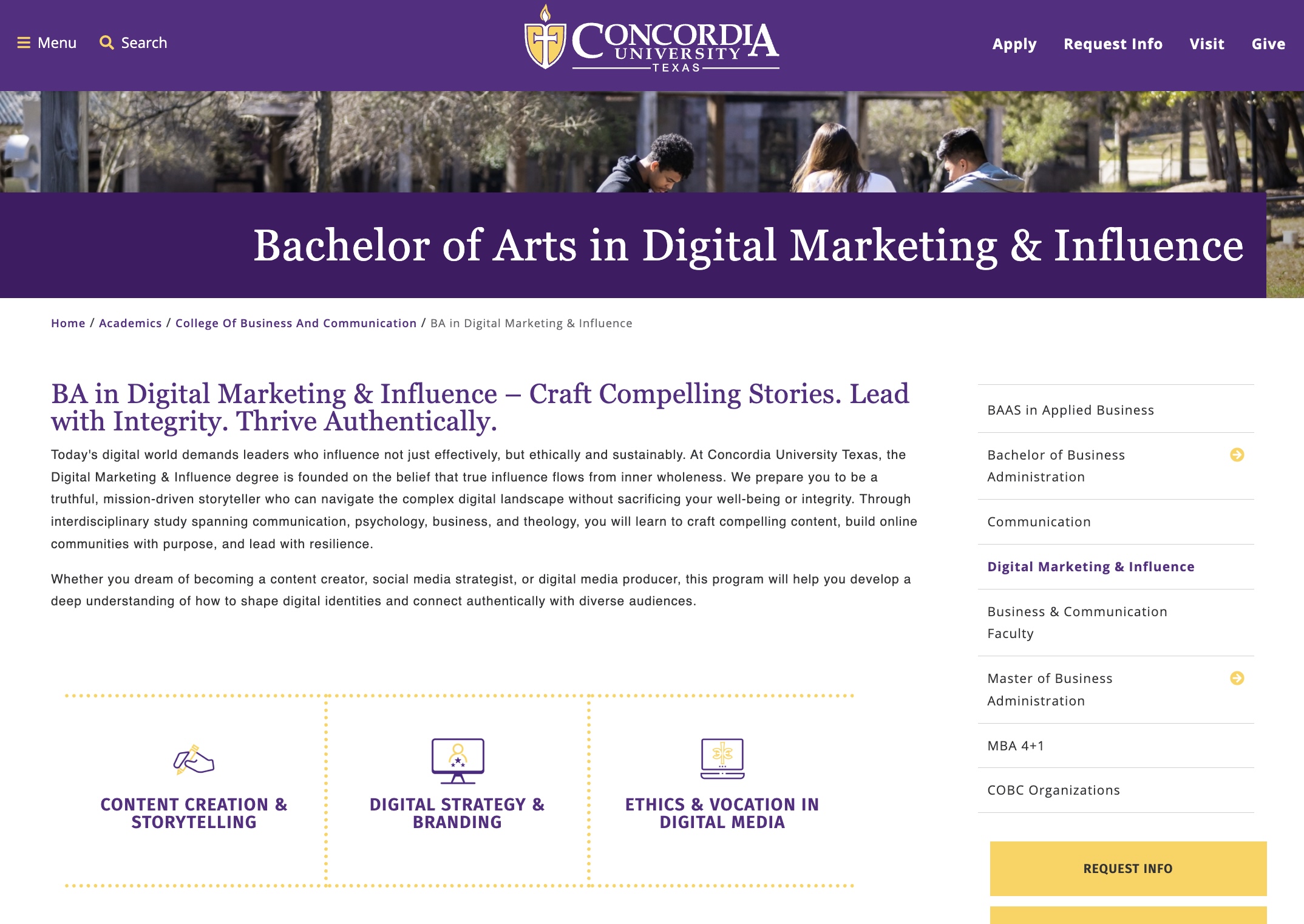
If a practice lives only in one professor’s classroom, it can disappear when a professor moves on. I wanted to build something that would last. So when I designed and began directing the new B.A. in Digital Marketing and Influence, I made contemplative work part of the degree itself—not something that depended on one person, but something woven into the program.
The program is founded on a premise that sounds backwards for a marketing degree: that real influence flows from inner wholeness. Students learn content strategy, analytics, and persuasion. They also take two required courses that turn their attention inward, because they're entering an industry where attention is extracted rather than earned, where the pressure to be always on leads straight to burnout, and where nobody will slow them down unless they learn to do it themselves.
 (opens in a new tab)
Digital Wellness Course
Students complete a full mindfulness training program over the first five weeks. They read the course text contemplatively: slowly, one chapter at a time, no scrolling. They practice noticing the urge to click as it arises and letting it pass without acting on it. They hold a device-free deep listening conversation with a partner, audit their own attention, and undertake a personal digital sabbath, writing a memo before and a reflection after. The course ends with students designing and then defending a sustainable digital wellness plan, one that integrates their professional goals with their values, health, and relationships. The aim isn't to reject technology. It's to help students engage with it on their own terms.
Digital Identity, Influence & Vocation Course
A course built around one question: Who am I, and what should I do with the influence I have?
This course is built around conversation, not content delivery. There is very little lecture. Each class meets around a question the readings raise but don't resolve, and students shouldn't expect me to resolve it for them either. As the syllabus puts it, their preparation and their presence aren't incidental to the course. They are the course.
GUIDING QUESTIONS
What kind of life do I actually want to live?
Who am I, and how did I come to believe that?
What does my digital presence actually reveal about me?
Do the roles and labels I wear online define me, or confine me?
What do I owe the people my influence reaches?
Is a meaningful life compatible with an ambitious career?
What obligations do I have to people I will never meet?
The readings come from Leading Lives That Matter and span an unusually wide range of traditions: Frederick Buechner and Hsun Tzu, Dorothy Sayers and Toni Morrison, Dietrich Bonhoeffer and Martin Luther King Jr., Abraham Joshua Heschel on the Sabbath and Wendell Berry on a life of quiet faithfulness. The questions can't be answered from inside any single tradition, and students from different backgrounds bring different and necessary resources to them.
The heart of the course is a reflection journal students keep after every class meeting. It isn't a reading log or a response paper. It's a practice of honest self-examination. Four times a semester, students choose which excerpts to share with me, an act of editorial judgment as well as self-disclosure. They're graded on the honesty and specificity of their reflection, not on arriving at the right answers.
The goal is not to arrive at conclusions but to sit with a question long enough that it begins to change how you see yourself and your work.